Values-Based Living: Integrity as a Non-Negotiable
What do your values actually mean to you?
Do you know what they are—beyond the words you’d like to believe describe you? Have you ever taken the time to define them with intention, or do they mostly exist as vague ideals you assume you’re living by?
For a long time, mine were the latter.
How I Came To Value Values
I was raised with a strong sense of right and wrong. I considered myself a person of integrity. I told the truth, tried to do right by people, and was loyal—sometimes to a fault. But I had never really examined what integrity meant to me, or whether I was living in alignment with anything I could clearly articulate as my own values.
That changed in my early thirties.
A long-term relationship came to a painful end, not all at once, but slowly—through confusion, avoidance, and a growing sense that something wasn’t right. During that period, we existed in an uncomfortable limbo. We weren’t together, but we hadn’t fully severed ties. His family didn’t know we’d separated, and some of them reached out to me when they couldn’t get in touch with him.
I remember feeling deeply resistant to the idea that this was somehow my responsibility. Why should I be the one fielding calls or smoothing things over when he was simply avoiding an uncomfortable conversation?
And then I got curious.
He wasn’t hiding something explosive. He was hiding something mundane. There would have been no fallout, no dramatic consequences—just discomfort. And yet, he was willing to let other people sit in confusion rather than tell the truth.
That realization landed hard.
If someone is willing to be secretive when the truth costs them very little, what happens when it costs them something meaningful?
That was the moment my definition of integrity crystallized.
The Line I Couldn’t Unsee
Integrity is doing the right thing—even if no one will ever know.
Once I saw that clearly, I couldn’t unsee it. I did a great deal of soul-searching that year, and I made a quiet but firm decision: I would never again build my life—or attach myself to someone else’s—without integrity as a non-negotiable.
That shift rippled outward.
At the time, my daughters were in late elementary and early middle school, and our family life was governed by an ever-expanding set of rules. The rules were well-intentioned, but they were unwieldy. The girls had no real buy-in, and honestly, no reason to care. Expectations were being imposed, not owned.
We transitioned to values-based living instead.
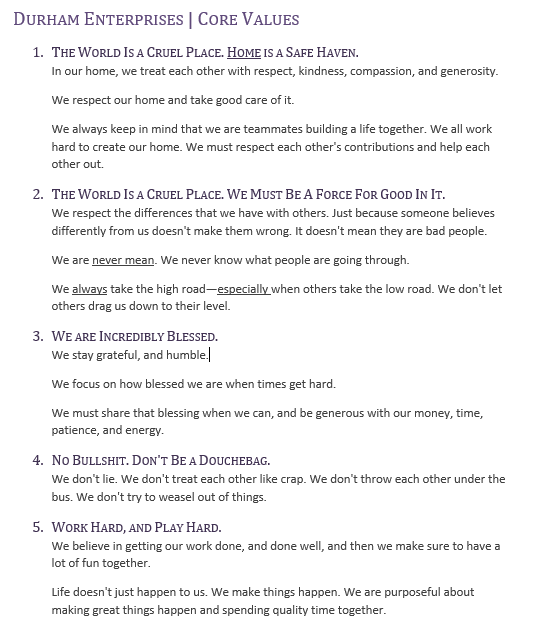
Rather than focusing on what not to do, we defined who we wanted to be—at home and in the world. We wrote those values down and lived with them—literally. They hung on our refrigerator for years, shaping everyday decisions in small, practical ways. They gave us language. They gave us alignment. And they changed the tone of our household in ways rules never had.
Fast-forward a decade, and my understanding of values has continued to deepen.
Integrity Isn’t A Value—It’s the Threshold
I now believe that values can evolve as we do. They’re shaped by reflection, experience, and growth. Integrity, however, is different.
Integrity isn’t a value. It’s a foundation.
It’s the commitment to live in alignment with what you say matters to you. It assumes a basic understanding of right and wrong, and it asks something more demanding than compliance. It asks consistency—especially when situations are messy, ambiguous, or uncomfortable.
Rules, laws, and even ethical frameworks are important. They create the minimum conditions for a functioning society. But values operate at a deeper level. They shape culture. They inform decisions when the path forward isn’t obvious. They answer the question: Who do I want to be when no one is telling me what to do?
This matters well beyond our personal lives.
What Values Actually Create
If you’re a business leader, your values determine how your organization shows up in the marketplace—and whether the trust you ask for is actually deserved.
If you’re a parent, they shape how your children learn to navigate a complicated world with compassion and accountability.
If you’re a business leader, how does your business show up in the marketplace such that you’re contributing good and positive things to all your stakeholders?
If you’re a parent, how are you teaching your kids to show up in their schools to spread positivity and love and light to a dark, hurting world?
Without values, there is no real culture—only rules enforced, or platitudes repeated for the sake of optics. And over time, that disconnect costs you: in trust, in engagement, and in the willingness of people to genuinely buy in.
So I’ll leave you with the same question I return to often:
What values are you living by—and how consistently are you living them?
This is the same work I now do with leaders and organizations—helping them clarify what truly matters and build structures that allow those values to be lived, not just stated.
If you’re ready to examine how integrity and alignment are—or aren’t—showing up in your organization, this work offers a place to begin.